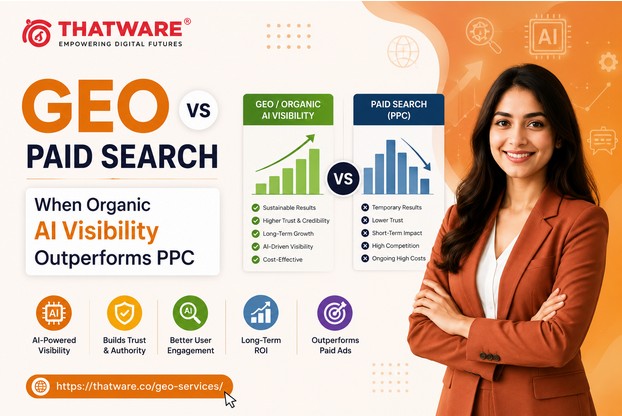
Let’s be honest — paid search has had a remarkably good run. For two decades, Google Ads was the closest thing digital marketing had to a reliable money machine. You could put in a dollar and, with enough optimization, consistently get more than a dollar back. Entire agencies were built on that premise. Entire industries were shaped by it.
But something is shifting. Not collapsing — paid search isn’t going anywhere soon. But its dominance is being quietly, structurally challenged by something that marketers are still figuring out how to name and measure: generative AI search.
When a buyer gets an answer from an AI assistant that includes a brand recommendation or a vendor shortlist, no one paid for that placement. It was earned. And increasingly, those AI-generated answers are happening before the person ever reaches a search results page with ads on it.
The Attention Problem Paid Search Can’t Solve
Here’s the core issue: AI assistants intercept queries. When someone asks Perplexity “what’s the best project management software for construction teams?” and gets a synthesized answer with two or three specific recommendations, the interaction is effectively over. They may not go to Google at all. They may not see a single paid ad.
This isn’t hypothetical — it’s measurable. Across industries, there’s a growing cohort of buyers — particularly in B2B, high-consideration consumer categories, and research-intensive purchases — who are beginning their research with AI rather than search engines. That cohort is expanding.
Paid search, by definition, only captures people who reach a traditional search results page. GEO vs SEO is a comparison that matters, but the more immediate business question is whether your brand has any presence in AI-generated responses at all — because that’s where a growing percentage of discovery is now happening.
Where Paid Search Still Wins
This isn’t an argument for abandoning PPC. Paid search has real advantages that GEO doesn’t replicate easily. Speed is one — you can launch a Google Ads campaign this afternoon and have traffic tomorrow. Geographic and demographic targeting precision is another. And for transactional queries with high commercial intent, paid search captures people at a moment of active purchase readiness that’s hard to beat.
For short-term campaigns, product launches, seasonal pushes, and categories where purchase decisions are made quickly, paid search remains highly effective. A local plumber running emergency service ads doesn’t need GEO strategy — they need to be in front of someone searching for “emergency plumber near me” right now, and paid search does that efficiently.
The calculus starts to shift in higher-consideration categories. Enterprise software. Professional services. Complex B2B products. Financial products. Healthcare. In these spaces, the buyer journey is long, research-intensive, and increasingly AI-mediated. A buyer evaluating ERP solutions isn’t going to click on an ad and make a $200,000 decision. They’re doing months of research, asking AI questions, reading analyst reports, and shortlisting vendors. That’s where GEO starts to outperform PPC on a cost-adjusted basis.
The Economics of AI Visibility
The ROI comparison between GEO and paid search is genuinely interesting, though still early to quantify with precision. Paid search has a direct, measurable cost per click. GEO has a less direct cost — mostly content creation, technical optimization, and sometimes agency fees — but it doesn’t have a per-click cost model.
More importantly, GEO investment compounds. Content that earns AI citations in year one doesn’t expire at midnight like an ad campaign. It continues to generate visibility as long as it remains accurate and authoritative. For companies with content marketing budgets, this compounding dynamic represents a fundamentally different return profile than the constant spend-to-sustain model of PPC.
Partnering with a best Generative Engine Optimization agency to build that foundation requires upfront investment, but the long-term economics look increasingly attractive compared to perpetually funding paid search clicks that evaporate the moment the campaign pauses.
The Synergy Case
The most sophisticated marketing teams aren’t choosing between GEO and paid search — they’re using both strategically and looking for the synergies. Paid search data tells you which queries are driving commercial intent; that data can inform GEO content strategy. GEO content builds the brand authority that makes paid search ads more effective when people do encounter them.
There’s also an interesting dynamic where AI search and traditional search co-exist in the same buyer journey. Someone might ask an AI assistant for an initial shortlist, then go to Google to compare specific vendors, where paid ads play a role. Having both AI visibility and paid presence across that journey is a meaningful competitive advantage.
The Practical Signal
If your cost-per-acquisition from paid search has been rising year over year — and for most competitive categories, it has — that’s partly a market efficiency problem that more bidding won’t solve. It might also be a signal that the attention landscape is shifting in ways that require a different kind of investment.
GEO isn’t a replacement for paid search. But for brands in high-consideration categories, it’s increasingly becoming a necessary complement — and in some contexts, the more cost-efficient growth channel. The companies that figure that out now are building advantages that their PPC-dependent competitors won’t easily close.